
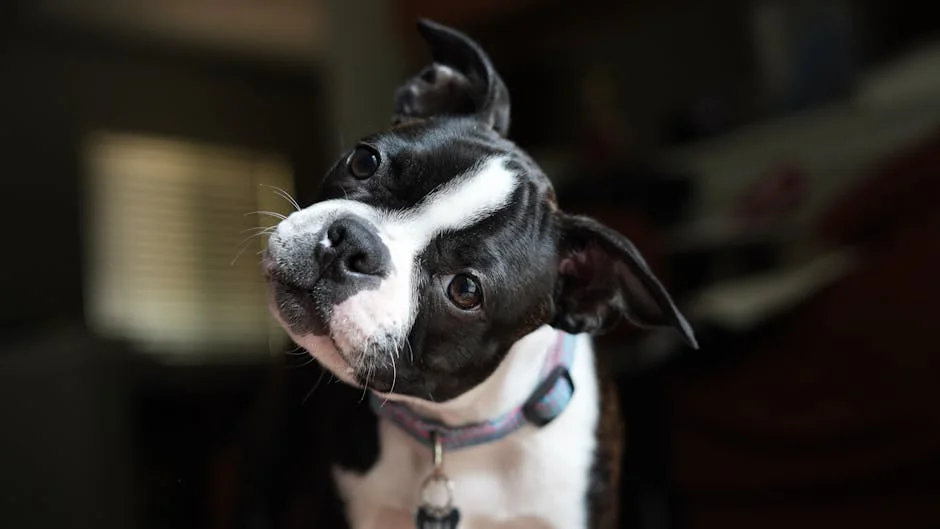
When you see your dog tilt their head while you speak, you are witnessing a complex blend of physical adjustment and cognitive processing. Understanding why your dog takes this posture helps you better decode their behavior and strengthen your communication.
The Physical Perspective: Better Auditory Alignment
One of the most practical reasons your dog tilts their head is simple acoustics. Canine ear anatomy is designed to capture sound, but it is not as omnidirectional as human hearing.
Adjusting the Pinnae
Your dog’s external ear structures, called the pinnae, act like satellite dishes. By tilting their head, your dog is literally changing the angle of their ears to improve their ability to localize the source of your voice. This adjustment allows them to filter out background noise more effectively and funnel sound waves directly into their ear canals.
Enhancing Sound Localization
If you are speaking to your dog from a distance or in an environment with multiple noise sources, the tilt helps them calculate the distance and direction of your speech. Think of it as a manual “fine-tuning” knob that allows them to pinpoint your mouth movements and the specific frequency of your voice.
The Cognitive Perspective: Processing and Empathy
Beyond the physical mechanics, head-tilting is a sign of high-level cognitive engagement. Research suggests that dogs who tilt their heads more frequently are often those with higher levels of “giftedness” or vocabulary recognition.
Matching Words to Meaning
When you use words that trigger a response—such as “walk,” “treat,” or “outside”—you are activating a specific area of your dog’s brain involved in language processing. The head tilt is a functional pause. Your dog is scanning their internal “database” of known sounds and patterns to match your vocal cues with expected outcomes or actions.
Reading Your Visual Cues
Dogs are visual creatures first and foremost. When you speak, you also change your facial expressions and posture. A head tilt allows your dog to see your mouth more clearly, which is a major focal point for them when interpreting speech. By tilting their head, they can look past the “obstruction” of their own muzzle to view your lips and facial expressions, helping them differentiate between a playful tone and a serious command.
Social Bonding and Reinforcement
The head tilt is a powerful social cue that serves to manipulate the interaction in your dog’s favor. It isn’t just about what they hear; it’s about how you respond.
The Feedback Loop
You have likely noticed that you tend to smile, laugh, or offer verbal praise when your dog tilts their head. This reaction reinforces the behavior. Because your dog wants to keep you engaged, they learn that the “cute” head tilt earns them your undivided attention and a positive reward. Over time, this becomes an intentional communication strategy they use to keep you interested in them.
Empathy and Emotional Mirroring
There is evidence to suggest that dogs use this posture to show they are “in sync” with your emotional state. Much like humans lean in when they are listening to someone they care about, dogs utilize the head tilt to demonstrate focused attention and social alignment. It is their way of acknowledging that they recognize your communication is directed specifically at them.
When to Observe Your Dog Closely
While frequent head tilting is usually a sign of intelligence or curiosity, it is important to distinguish between social behavior and potential health issues.
- Tracking the tilt: If your dog tilts their head consistently throughout the day, even when no one is talking, it may indicate an ear infection or a vestibular disorder.
- The “Fixed” Tilt: If the tilt is accompanied by loss of balance, circling, or rapid eye movement (nystagmus), contact your veterinarian immediately.
- The “Engaged” Tilt: If the tilt only happens while you are interacting, playing, or speaking, it is almost certainly a healthy behavioral response to your communication.
By observing when and why your dog performs this action, you gain a deeper understanding of their personality and their perception of your relationship. Continue speaking clearly, and enjoy the visual confirmation that your dog is truly listening to every word you say.