
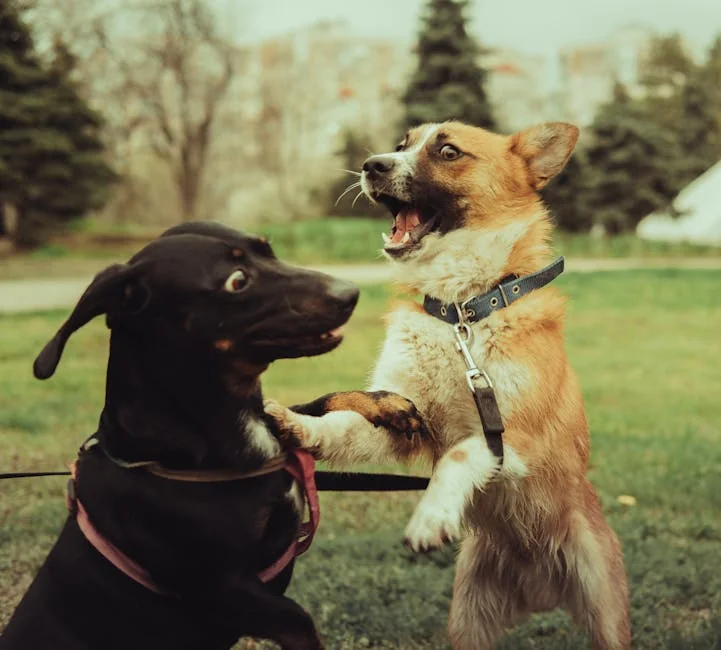
Interpreting canine body language without the proper knowledge is like trying to navigate a foreign country without a translation guide. You might think you understand what your dog is saying, but misinterpreting their cues can lead to training regression, damaged trust, or even dangerous situations. By understanding the most misunderstood dog behaviors, you can prevent conflict and build a deeper, safer bond with your companion.
The Tail Wag Is Not Always Friendly
The most pervasive myth in dog behavior is that a wagging tail equals a happy dog. While a happy dog will wag its tail, a wagging tail simply visualizes arousal or emotional engagement. It is an energy meter, not a mood meter. To understand the intent, you must look at the specific mechanics of the wag and the rest of the dog’s body.
Speed and Tension
A loose, sweeping wag that involves the entire rear end (often called a “wiggle butt”) indicates friendliness and joy. However, a stiff, vibrating wag held high like a flag often signals high arousal, assertiveness, or potential aggression. If the tail is moving slowly and stiffly, the dog is evaluating a situation and may be preparing to react defensively.
Directional Wags
Research suggests that dogs tend to wag more to the right when they encounter something positive (like their owner) and to the left when facing a negative stimulus (like a strange, dominant dog). While you don’t need to overanalyze degrees of movement, paying attention to general tension is crucial. If the tail is wagging but the body is frozen still, do not approach.
The Myth of the “Guilty Look”
You come home to find trash scattered across the kitchen floor. Your dog is cowering in the corner, ears pinned back, showing the whites of their eyes (whale eye). You assume they know what they did was wrong and feel guilty.
This is a human projection. Dogs do not experience guilt in the way humans do; they experience fear and appeasement.
When your dog offers this behavior, they are reacting to your body language, tone of voice, or the general tension in the room. They recognize that “trash on floor” plus “owner present” equals “bad things happen,” so they offer appeasement signals to calm you down. Scolding a dog in this state does not teach them not to get into the trash; it only teaches them to be afraid of you when trash is present.
Growling Is a Good Thing
It feels counterintuitive, but you should value a growl. Many owners punish their dogs for growling, believing it is an act of dominance or unprovoked aggression. In reality, growling is an essential warning system.
When a dog growls, they are communicating, “I am uncomfortable, please stop what you are doing, or I may have to bite.” It is the final verbal warning before physical action.
If you punish a dog for growling, you are removing the warning system. The dog learns that communicating discomfort results in punishment. The next time they are scared or in pain, they may skip the growl entirely and proceed directly to a bite. When a dog growls, simply stop your current action, step back, and assess what made the dog uncomfortable so you can manage the situation differently next time.
Yawning and Lip Licking Are Stress Signals
If your dog yawns while curling up in their bed at night, they are tired. However, if your dog yawns while you are hugging them, at the vet, or during a training session, they are not sleepy. They are stressed.
Displacement Behaviors
Yawning and lip licking (when no food is present) are displacement behaviors. These are things dogs do to relieve internal tension or diffuse a perceived threat. If you are teaching a new command and your dog starts yawning repeatedly or scratching incorrectly, they are likely confused and feeling pressure.
Ignoring these signs pushes the dog over their threshold. If you see these signals, take a break, lower the criteria, or remove the dog from the stressful environment.
Mounting Is Rarely About Dominance
Few behaviors are as embarrassing to owners as a dog mounting another dog, a human leg, or a plush toy. The immediate assumption is that the dog is trying to be the “alpha” or assert dominance.
In the vast majority of cases, mounting is a response to overstimulation or excitement. It is a common behavior in play parks where the energy level is too high for the dog to regulate. It can also be a sign of anxiety or a compulsive habit formed to relieve stress.
Correcting mounting requires managing the dog’s arousal levels. Instead of scolding them for being “dominant,” intervene by removing the dog from the high-energy situation and giving them a chance to calm down.
The Belly Rub Trap
A dog rolling onto its back is typically seen as an invitation for a belly rub. While this is often true for a relaxed dog in a familiar environment, it can also be an extreme submission signal.
If a dog rolls over but their body is stiff, their tail is tucked between their legs, and their mouth is closed tight, they are saying, “I am harmless, please don’t hurt me.” Reaching for a dog in this state can be terrifying for them and may trigger a defensive snap.
Always check the muscle tone. A floppy, loose dog wants a rub. A stiff, frozen dog wants space. By respecting these distinct signals, you show your dog that you are a safe, understanding leader who speaks their language.